What the World Cup and America’s 250th Tell Us About the Next Chapter of American Enterprise.
By Rohit Arora, CEO & Co-founder of Biz2Credit
Welcome to the Arora Analysis. Every month, we'll dive back into trending topics and financial monitors, indexes, and ground-level insights to map out exactly how we can collectively strengthen the backbone of our economy: SMBs.
I. The Convergence
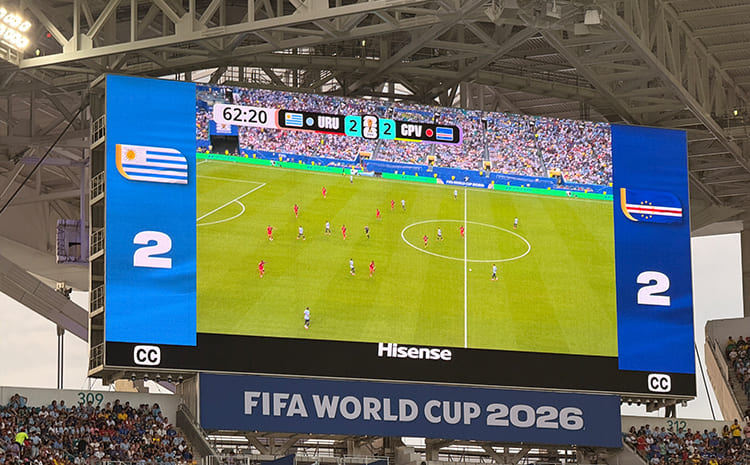
Over the next month, America turns 250, and, for the first time in 32 years, the FIFA World Cup is being played on U.S. soil—in our stadiums, in our cities, and in front of our neighbors.

Theodor Reik famously wrote “history doesn’t repeat itself, but it often rhymes,” an adage I generally subscribe to. But this summer offers something different.
It may seem natural to treat these as entirely separate occasions: one political, one athletic; one historical, one recreational. That read misses the larger context of these events.
Both are, at their core, centered on the exact same social experiment: what happens when people from radically different origins organize around a shared, high-stakes goal. In this country, that dynamic has a specific structural name. We call it entrepreneurship.
The convergence of 48 nations competing on the pitch and a 250-year-old socioeconomic experiment offers more than shared celebration. It provides a stark look at the mechanics of American competitiveness. The growth drivers of the last two and a half centuries are under immense structural pressure, and it’s safe to say what got us here will not get us there.
Understanding where we go next requires looking closely at the data behind Main Street as we know it today.
II. The Melting Pot is Not a Metaphor—It’s a Balance Sheet
“Main Street USA” may sound nostalgic, but the small business backbone of our economy does not run on cultural sentiment. It runs on capital, labor, and output. When we analyze the American small business economy, the data reveals that immigration is not an ideological talking point. It is a core asset class on the national balance sheet.
Consider the baseline data. According to the Immigration Research Initiative, immigrants make up 27% of all Main Street business owners nationwide, including 34% of restaurant owners and 33% of grocery and supermarket owners. Data from the American Immigration Council further confirms that immigrant entrepreneurs represent 23.6% of all business owners across the United States, driving more than one-third of all enterprises in the accommodations and food services sectors.
This impact scales from the local bodega to the global market. 46.2% of Fortune 500 companies were founded by immigrants or their children. In fiscal year 2024, these firms generated $8.6 trillion in revenue. Iconic American brands—including Apple, Amazon, Ford, Disney, McDonald’s, and Costco—all reflect the foundational contributions of first- and second-generation Americans.
“The diversity of the small business economy is not a coincidence of history. It is the architecture of our growth.”
The connection to the current sporting moment is structural. There are 48 nations on the pitch this summer. The U.S. small business economy already employs talent and leaders from all of them. At Biz2Credit, the data across our portfolio of more than 250,000 borrowers mirrors the exact diversity seen in the stadium stands. This is not a coincidence of history; it is the deliberate design of American economic expansion.
III. The Field Was Never Flat, But the Dream Was Always Real
The historical through-line from 1776 to 2026 shows that the American economic engine was never static. The small business ecosystem has evolved continuously alongside the country itself. The economic foundation shifted from colonial merchants and blacksmiths to immigrant-owned urban shops, and later to the manufacturing hubs and digitized Main Street retailers of today. Small businesses have powered every single era of American expansion, adaptation, and reinvention.
What historically separated the United States from other global markets was a distinct institutional framework: robust economic freedom, secure property rights, the rule of law, open markets, and a culture that actively de-stigmatized and celebrated risk-taking.
However, the defining characteristic of this 250-year arc is not stability. It is the sustained willingness of entrepreneurs to deploy capital and take risks precisely when certainty is absent. Every small business owner who successfully scales an enterprise embodies this disposition. The difficulty lies in the fact that the next chapter of American enterprise will require this risk-tolerance and resilience in far greater measure, under far less favorable conditions.
IV. The Pivot: What Got Us Here Won’t Take Us There
The playbook that enabled American business growth over the last several decades assumed a highly stable economic environment: a predictable dollar, globalized and open supply chains, consistent regulatory frameworks, and cheap capital. In 2026, none of those assumptions stand. Three structural forces are colliding simultaneously, rendering the old playbook obsolete.
1. Geopolitical Fragmentation
Transactional diplomacy and shifting international alliances have accelerated the rise of a fragmented, multipolar world. As noted by InsightForward, global business strategies must now treat volatility as a permanent operational factor rather than a temporary exception. Supply chains designed for frictionless globalization are facing severe stress tests from sudden tariffs, reshoring mandates, and regional power realignments.
2. AI as a Dual Accelerant and Disruptor
Advanced technology is shifting the baseline of corporate capability. While artificial intelligence offers massive productivity gains and strategic resilience for organizations prepared to adapt, it simultaneously threatens to widen the gap between legacy operators and agile firms. AI disproportionately rewards the operator who integrates it into their workflow before market forces give them no choice.
3. Capital Access Constraints in a Tightening Policy Environment
Compounding these macroeconomic shifts are direct regulatory headwinds. New Small Business Administration (SBA) guidance restricts small businesses without 100% U.S. citizenship ownership from accessing core agency-backed loan programs. This policy environment is tightening access to traditional credit at the exact moment that shifting supply chains and tech transitions demand maximum financial flexibility.
The operational reality is clear: businesses that treat the previous era's stability as permanent are facing the highest level of risk. The enterprises that will define the next chapter of American commerce are not those waiting for clarity from central banks or regulators. They are those restructuring their operations for an era of persistent friction.
Our Q1 2026 Small Business Credit Monitor proved that a disciplined subset of Main Street is standing out—showing a 37% year-over-year surge in portfolio revenue and a tripling of aggregate operating profits. Debt-service coverage improved remarkably from 0.57x to 1.40x, driven largely by lean, service-heavy firms outperforming goods-heavy sectors hit by trade and tariff uncertainties. But the economic climate doesn’t stand still. Next month, we are releasing the Q2 mid-year Small Business Credit Monitor: are these hard-won margin gains holding up against surging manufacturing input costs, or are tightening credit lines finally catching up on Main Street?
V. Resilience Is Not a Personality Trait—It’s a Decision
In the World Cup tournament structure, the teams that advance are rarely those relying solely on raw, unadjusted talent. Survival requires tactical adaptability—the organizational capability to read an opponent’s new alignment, shift systems mid-match, and execute under pressure without a historical playbook.

American enterprise must adopt an identical operational posture. For small and mid-sized businesses navigating the current macroeconomic transition, resilience requires pulling three specific structural levers:
- Access to Flexible Capital: Operators must diversify their funding mechanisms. Relying on a single banking relationship or a single traditional credit channel creates existential risk when policy shifts or credit cycles tighten.
- Mandatory Technology Adoption: Deploying AI and automated operational tools is no longer about driving incremental efficiency. It is a defensive necessity to compress the capability gap between small enterprises and massive corporate institutions.
- Market and Supply Diversification: Concentrating operations within a single customer segment, marketing channel, or geographic supplier network exposes a business to immediate disruption. Modern operational stability requires intentional redundancy.
This is where the financial ecosystem must evolve. The role of financial technology platforms is no longer just to act as standard capital allocators. The objective must be providing the underlying infrastructure layer that enables rapid small business adaptability.
VI. The Bet Is Still On
America did not survive and expand for 250 years because macroeconomic conditions were consistently favorable. It survived because its builders adapted faster than the conditions changed.

The World Cup brings 48 nations to American cities this summer. A significant portion of those nations have their own small business owners watching from the stands—individuals who immigrated here, or whose parents did, to construct an enterprise in a market that promised a fair shot at high-stakes risk.
The next 250 years will demand the exact same execution from them, and from the institutions tasked with financing them. The terms of the market have fundamentally changed. The bet on American entrepreneurship, however, remains well worth making.
See you next month.
References
- SBE Council. (2026). America 250: Immigrant Entrepreneurs and the American Dream. sbecouncil.org
- U.S. Chamber of Commerce. (2026). Founded: The Small Businesses That Built America. uschamber.com/co
- Immigration Research Initiative. (2026). The Entrepreneurial Spirit: Main Street Business Ownership. immresearch.org
- American Immigration Council. (2025). Fortune 500 New Americans Report. americanimmigrationcouncil.org
- InsightForward. (2026). Top 10 Geopolitical Risks for Business 2026. insightforward.co.uk
- EY. (2026). Midyear Global Economic Outlook: Strategic Resilience in a Supply Shock World. ey.com
- Small Business Majority. (2026). Immigration Policy Fact Sheet and SBA Lending Frameworks. smallbusinessmajority.org